

Ask a Velachery family about rain and you will hear two kinds of story. One is about 2015, or December 2023, when water came into homes. The other is about a road that stays under water after a heavy spell, and how long it takes to drain. If you are buying a home here, both are worth understanding, and the second is the one you are more likely to live with.
Velachery flooding in 2015 and 2023
December 2015 brought one of the worst floods Chennai has seen. One Velachery resident told The News Minute that on his street, the water crossed the first floor.
Since then, the Greater Chennai Corporation has built storm water drains in several parts of Velachery. They were in place by December 2023, when Cyclone Michaung brought more than 20 cm of rain in a day. The India Meteorological Department recorded 29 cm at Perungudi and 25 cm at Alandur in the 24 hours to the morning of 4 December. The News Minute reported four feet of water in most residential neighbourhoods of Velachery on 5 December. One resident told the paper they had expected the new drains to cope, though not with that much rain.
What most monsoons look like
A flood on the scale of 2015 or 2023 takes exceptional rain. What Velachery families deal with more often is waterlogging: water standing on the road after a heavy spell. Two things decide how much it disrupts your life. How quickly the water drains away depends on your street. Whether it reaches your home depends on how high the building stands above the road.
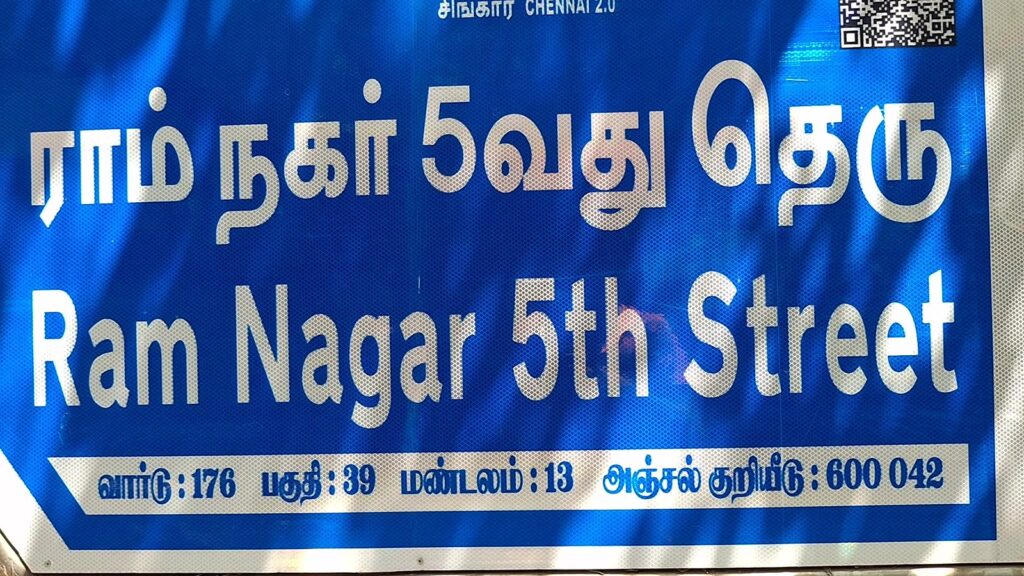
What Velachery flooding looked like on 5th Street
Our plot is on 5th Street in Ram Nagar North Extension, and Ramnagar was among the neighbourhoods The News Minute named in 2023. At the time an older building stood on the plot. The water on the road outside it reached about 2 to 2.5 feet.
How we built Sapthaswarangal after 2023
We demolished that building and built Sapthaswarangal in its place.
The plinth is 3.5 feet above the road, a foot to a foot and a half higher than the 2023 water. The ground floor is for parking only, so there are no homes at ground level and the lowest flat is a full floor up. The top of the sump is raised a further six inches, to four feet above the road, to keep floodwater out of the water supply.

So when the road waterlogs, the homes sit well above it. The inconvenience is a street you may not want to drive through until it drains.
What to ask at any home in Velachery
Ask how high the plinth is above the road, and what the road did in 2023. Ask whether anyone lives on the ground floor. Then ask the neighbours how long the water took to clear last monsoon. At Sapthaswarangal you are welcome to measure the plinth yourself.
See it for yourself
If Velachery flooding is the question holding you back, come and look at the building with it in mind. Sapthaswarangal has six ready-to-move 3BHK homes of 1,470 and 1,477 sq ft built-up. Book a visit through the form on the project page, where the prices and full specification are listed. To hear from people who already live in an Abimaan building, you are welcome to walk in at Shashti Avenue in Vandalur and speak to the residents.
For the rest of the neighbourhood, schools, shops and the hospital, read our guide to living in Velachery.
1 thought on “Velachery flooding: what has changed since 2015, and what still happens after heavy rain”
Pingback: Ready to Move vs Under Construction Flats in Chennai